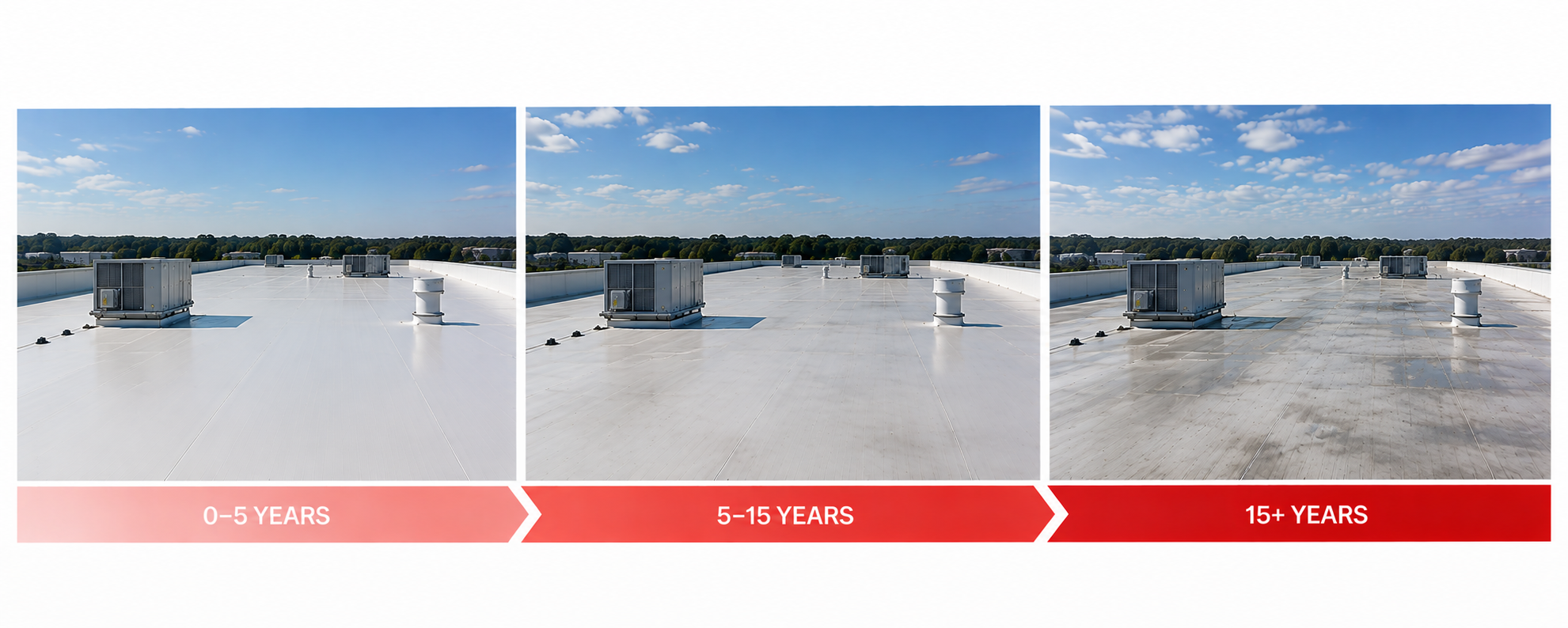
How do you know when a commercial roof needs to be replaced?
Signs that a commercial roof may need replacement include recurring leaks, widespread membrane deterioration, saturated insulation, damaged flashing, persistent drainage problems and increasingly frequent repairs.
However, roof age or isolated damage alone does not necessarily mean replacement is required. A professional roof assessment can help determine whether repairs, recover, retrofit or full replacement is the most appropriate solution.
Routine inspections and preventive maintenance can help identify potential problems early. Learn more in our commercial roof maintenance guide.
Is a full commercial roof replacement always necessary?
No. Depending on the condition of the existing roofing assembly, localized repairs, roof recover or retrofit may be viable alternatives to a complete tear-off.
The appropriate solution depends on factors such as moisture intrusion, insulation condition, structural requirements, existing roof layers and applicable building codes. A qualified roofing contractor can assess these conditions and help determine the best approach.
Find an Elevate Licensed Contractor to discuss your roofing project.
What is the difference between commercial roof replacement and roof recover?
Commercial roof replacement typically involves removing the existing roofing assembly and installing a new system. A roof recover involves installing a new roofing system over an existing roof when conditions permit.
A recover may reduce tear-off waste, disposal requirements and disruption to building operations. However, the existing assembly must be evaluated for moisture, structural capacity, compatibility and applicable building code requirements.
Certain roofing products are designed for recover applications. Explore Elevate TPO roofing systems, including UltraPly TPO XR, to learn more.
Can you install a new commercial roof over an existing roof?
Yes, in some cases. A commercial roof recover may be possible when the existing roofing assembly is in suitable condition and meets applicable building code and manufacturer requirements.
Wet insulation, multiple existing roof layers, deteriorated materials or structural concerns may prevent a recover and require removal of some or all of the existing assembly. A qualified roofing professional should evaluate the roof before determining whether an overlay is appropriate.
How long does a commercial roof replacement take?
The timeline depends on roof size, existing conditions, roofing system selection, weather, material availability and building operations.
Projects requiring extensive tear-off, deck repairs or drainage improvements may take longer than installations over suitable existing assemblies. Building access and the need to maintain business operations can also affect scheduling.
An experienced roofing contractor can provide a project-specific timeline following an assessment. Learn more about choosing a qualified commercial roofing contractor.
What factors affect the cost of commercial roof replacement?
Commercial roof replacement costs vary based on roof size, existing roof conditions, tear-off and disposal requirements, insulation needs, membrane selection, attachment method, drainage improvements and labor.
Building access, local code requirements, project complexity and warranty considerations can also influence costs. A roof recover may reduce certain removal and disposal expenses when the existing assembly is suitable, but the lowest initial installation cost is not always the best long-term value.
Building owners should compare the complete roofing assembly, expected performance and maintenance considerations when evaluating proposals. Explore factors to consider when selecting a commercial roofing system.